











Sanctions fail to curb Sudan’s war economy
12 November 2026
Earlier this month, Australia imposed targeted sanctions and travel bans on three leaders within the Rapid Support Forces, their adversary army chief Abdel-Fattah al-Burhan, and the allied Islamist militia, the Bara-bin Malik Brigade. A week earlier, the United Kingdom issued targeted sanctions against 15 senior commanders from both the Rapid Support Forces (RSF) and the Sudanese Armed Forces (SAF). All of this follows the October 8 UN Security Council unanimous resolution extending the 1591 Sudan sanctions for a two-month period that includes targeted travel bans and asset freezes on individuals within the warring parties.
But despite this and ongoing US-targeted, list-based sanctions—primarily under Executive Order 14098—the conflict continues unabated, with seemingly little damage to those facing international scrutiny.
International sanctions have disrupted parts of the financial and procurement networks sustaining Sudan’s war but have done little to stop the warring parties from financing their campaigns or committing abuses, according to recent research by the Sudan Transparency and Policy Tracker (STPT).
Since the war began on April 15, 2023, international sanctions have targeted commanders, companies linked to the two forces, their commercial partners and alleged facilitators. Yet both military establishments continue to exploit resources in territories under their control, directing revenues towards private enrichment and financing their military campaigns.
STPT finds that sanctions have raised costs and disrupted some established financial and procurement channels but have not deprived either side of the resources or external relationships needed to continue fighting.
Designated businesses can shift activities between jurisdictions, operate through unsanctioned subsidiaries and establish new commercial relationships that make transactions harder to trace.
Red Rock, Zadna, and Al Junaid
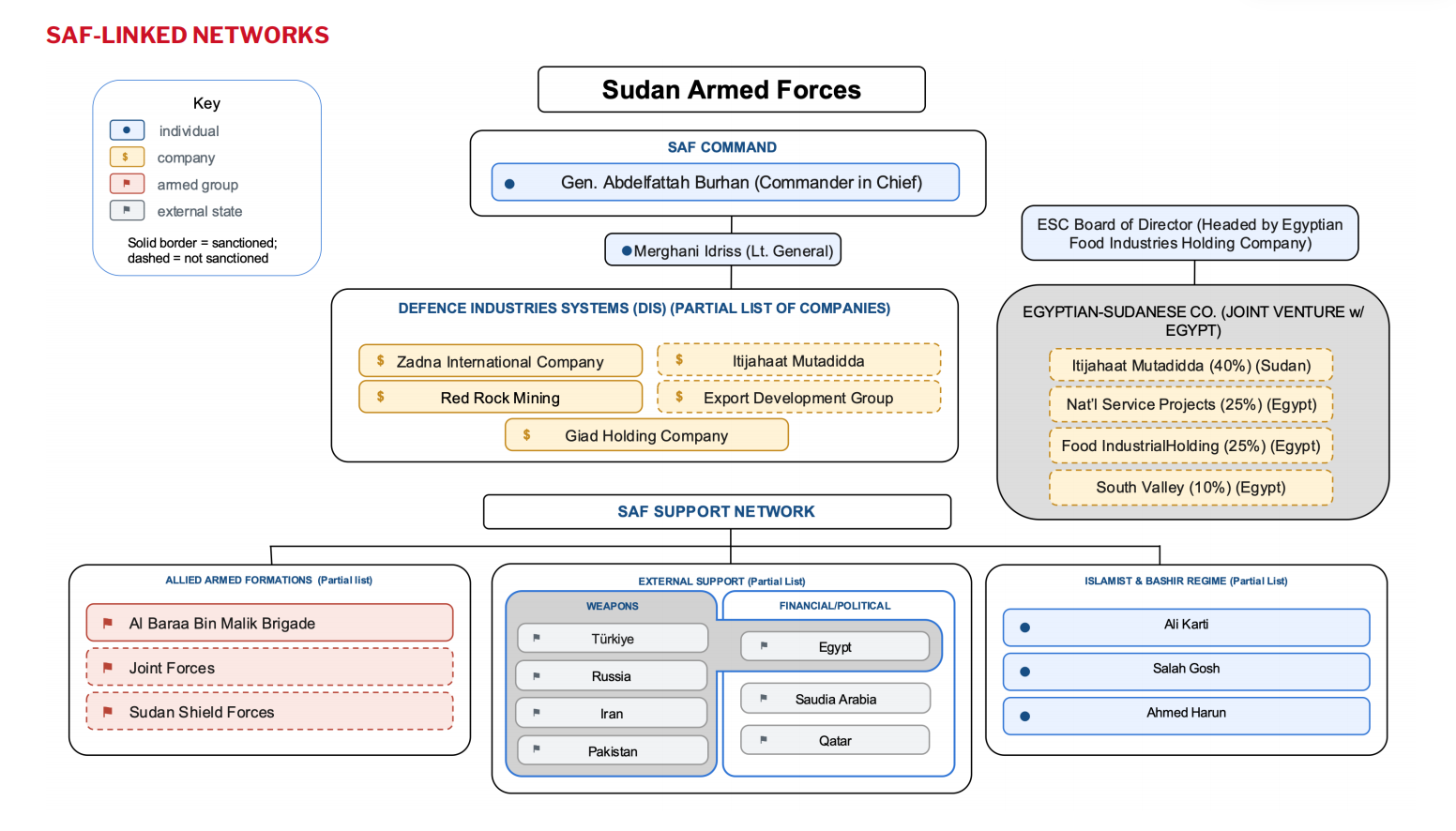
Take, for example, the resiliant, SAF-aligned Red Rock Mining Company, accused by foreign governments of funding the SAF, linking the company’s mining profits to the conflict. Despite facing sanctions from the UK, the EU, and Switzerland, Red Rock has simply pivoted, leveraging a network of international corporate vehicles to keep its operations humming. By late 2025, the firm was still boasting a global footprint across Tanzania, Ethiopia, and the United Arab Emirates (UAE) – even maintaining a European foothold through a Rotterdam-based “sister company”, Red Diamond Industries.
Fellow military-affiliated firm Zadna mirrors this corporate resilience, relying on Egypt-based partnerships and domestic dominance to render Western penalties practically toothless. Shielded by state support within SAF-controlled territories, Zadna continues to secure lucrative contracts and financing without facing significant operational blowback, STPT reported.
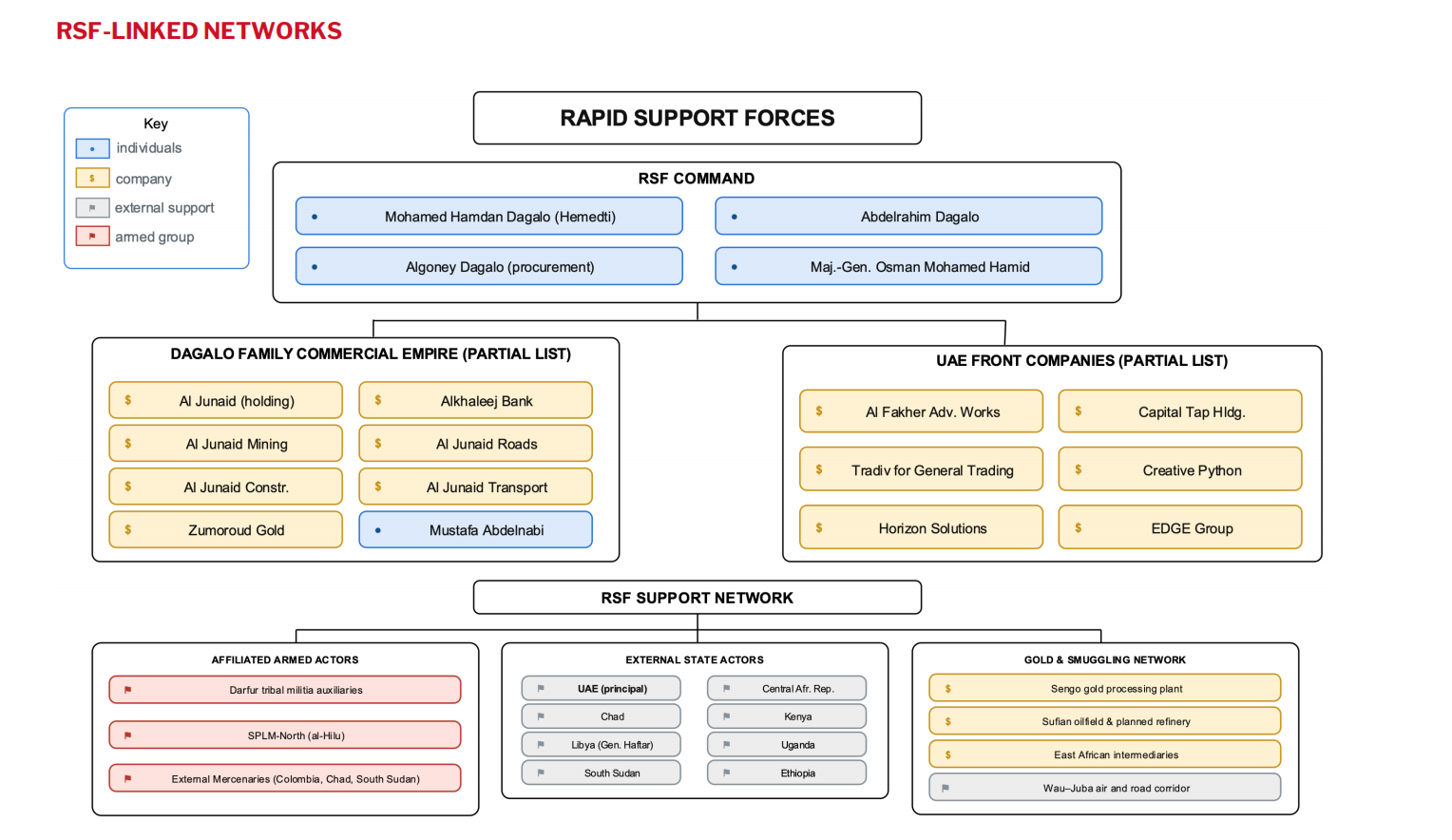
In turn, Al-Junaid Co. Ltd., an RSF holding company with subsidiaries in mining, construction, and transport, has survived multiple sanctions regardless of its pivotal role in financing the conflict. Despite facing international sanctions from the US, UK, EU, and Canada, Al Junaid remains a central pillar of the militia’s self-sustaining war economy. The company has maintained its gold production operations, even resuming activities after Sudanese Armed Forces (SAF) airstrikes disrupted its Sungu mining facility in 2024.
To bypass sanctions and sustain a flow of hard currency, the RSF leverages Al Junaid to orchestrate complex regional smuggling networks, STPT reported. High-value “conflict gold” processed at Al-Junaid facilities is transported through emerging East African hubs—including South Sudan, Kenya, Uganda, and Tanzania—before reaching the United Arab Emirates via private flights. Supported by the strategic bribery of local leaders to secure mining sites, Al Junaid effectively launders domestic resources into international markets to finance the RSF’s ongoing military operations.

Sudan’s war: Competing economic empires
For Suliman Baldo, Executive Director of the Sudan Transparency and Policy Tracker, the limitations of sanctions cannot be understood without examining the economic interests at the centre of the conflict. Speaking to Ayin, the Sudanese researcher argued that the war is not simply a struggle between two commanders seeking political power. Rather, it is a confrontation between competing commercial empires rooted in the same military-security establishment.
“The main reason for the war is not because Burhan and Hemedti were seeking to take power individually,” Baldo said. “It is because they were protecting competing and irreconcilable economic interests across gold, banking, agriculture and livestock.” He described the conflict as a dispute within a military-security establishment that had survived a system of “military kleptocracy.”
That competition, Baldo said, helps explain how businesses associated with both forces have adjusted to sanctions. He said companies linked to the Dagalo family, which heads the RSF, had established a substantial presence in the UAE through multiple incorporations. In turn, businesses associated with the SAF rely on commercial relationships in friendly countries, including Egypt. Such arrangements could help evade restrictions by avoiding dollar-based transactions.
Baldo warns that sanctions and diplomacy would have limited value if a peace process left the military’s economic structures intact. “The civilians have to be very careful that the peace process does not end up leading to a division of the benefits between the warring parties,” he said. “They should recognise these economic interests as the primary motivator, the primary driver of the violence, and address them in their peace proposals.”
Dismantling the military’s commercial empires and establishing genuine civilian-led democratic reforms must therefore be central to any durable settlement, Baldo argued. Without that transformation, negotiations risk reproducing the kleptocratic arrangements that helped generate the conflict in the first place.

Sanctions need enforcement and wider accountability
In some cases, even the countries that impose sanctions do not seem to pay heed to their own punitive measures against the warring parties. In October last year, Washington invited RSF deputy commander Al-Goni Dagalo to the states to help negotiate a humanitarian ceasefire, despite imposing sanctions on him. Such engagement can weaken the deterrent effect of sanctions, Baldo said, if diplomatic priorities can eclipse them.

Instead of loosely applying sanctions, says Jonas Horner, a visiting fellow of the Africa programme at the European Council on Foreign Relations, sanctions against Sudanese armed actors must be expanded and part of a wider arsenal of diplomatic pressures. So far, he told Ayin, sanctions have not meaningfully deterred either warring party from targeting civilians because both sides regard abuses as integral to their military objectives.
“The two sides would rather perpetrate horrific and sanctionable offences and wear the impact of those (offences) than stop targeting civilians en masse,” Horner told Ayin. “So ultimately (sanctions) need to be part of a larger package pressuring both sides.”
Horner believes that the denial or obstruction of food aid, which violates international humanitarian law, should be added to the list of sanctionable offences, along with better tracking of arms shipments.
Foreign backers of the RSF and SAF should also face greater pressures. “External actors should be held closer to the fire for their role in stoking and worsening the war and its impacts,” Horner said. “I do feel it’s perhaps wishful thinking given the profile of the actors involved, all of whom have deep, strategic relationships with the countries most likely to sanction them.” Horner added that UN member states, renowned for pushing for sanctions, continue to prioritise their connections with Arab world players over their readiness to respond effectively to the Sudanese crisis.
More will, consistency
Both Baldo and Horner believe that without consistent enforcement and a coherent political strategy, the current regime of sanctions remains limited. Targeted restrictions may disrupt transactions, raise costs and expose commercial networks, but the parties have shown they can adapt while retaining access to resources and external support. The challenge, Baldo and Horner suggest, is not simply to add names to sanctions lists. It is to follow the money, close the corporate and jurisdictional routes used to evade restrictions, and impose consequences on those sustaining the war from outside Sudan.