


From Ukraine to Sudan: How drones and jamming equipment are changing the war
6 March 2026
Sudan’s war has transformed into a conflict of the skies, incorporating unmanned aerial vehicles (UAVs) and jamming systems in a pattern that mirrors the tactical evolution seen in Ukraine. Independent satellite monitoring and conflict reporting show that drones have been striking civilian and military targets across Sudan, killing thousands and displacing millions.
United Nations human rights officials recently reported that both the Sudanese Armed Forces (SAF) and the paramilitary Rapid Support Forces (RSF) used UAVs in strikes that killed at least 57 civilians in multiple states, including markets, shelters, and schools. Rights monitors have characterised repeated UAV strikes on residential areas as not merely tactical but systematic, indicating deliberate targeting patterns often inconsistent with military necessity. One example documented by the Euro-Med Human Rights Monitor involved RSF drone strikes in North Kordofan, South Kordofan, and Sennar that killed civilians in densely populated zones with no evidence of nearby military objectives.
Open-source mapping of drone usage reveals this technology is not concentrated in a single province. Attacks have been recorded in Khartoum, Kordofan, and eastern states such as Kassala and Port Sudan, where multiple suicide drones targeted fuel tanks, airbases, and civilian infrastructure, leading to secondary effects like airport closures. The geographic breadth of these operations underscores how UAV deployment in Sudan extends far beyond isolated skirmishes – it is central to both offensive and defensive strategies.
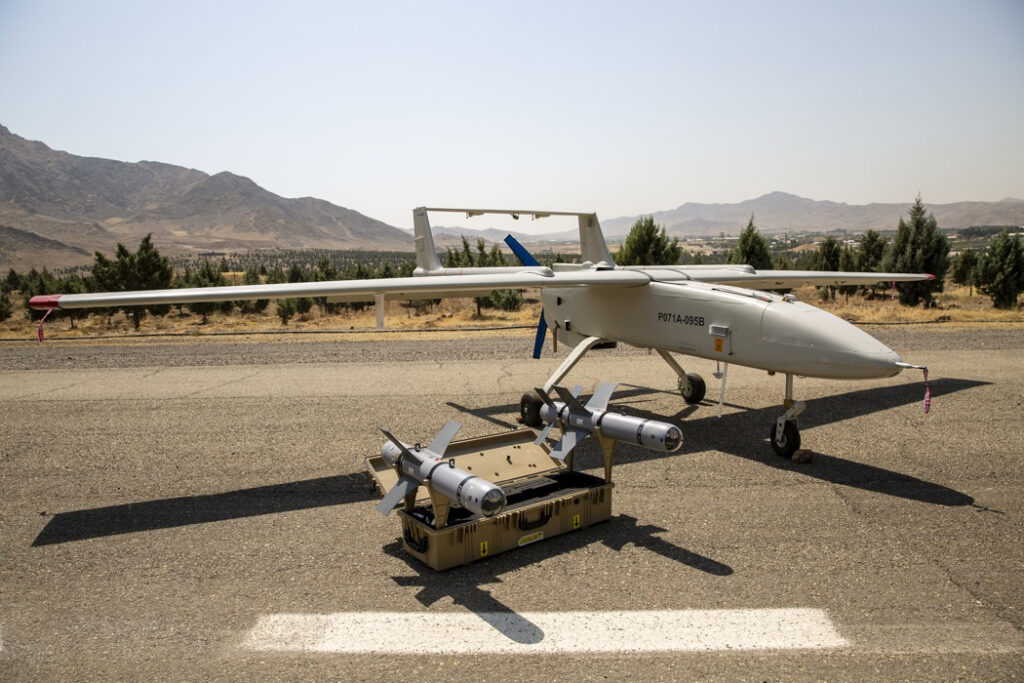
The types of systems documented range from small tactical quadcopters adapted for close-range targeting to larger reconfigurable designs capable of carrying payloads like explosives or mortar ordnance. Local analysis and interviews with former Sudanese pilots indicate that SAF forces deploy a mix of Turkish, Iranian, and Chinese platforms, while the RSF uses Chinese models and modified commercial drones for loitering munitions and harassment strikes.
Ayin open-source investigations previously verified evidence that both sides use UAVs for more than just reconnaissance roles, including direct strikes on infrastructure, supply lines, and defensive positions.
The invisible battle – electronic jamming and signal warfare
Parallel to the rise of drones in Sudan’s war is a subtler but equally consequential evolution: electronic warfare (EW). In the Ukraine war, Russian and Ukrainian forces developed increasingly aggressive anti-drone and jamming systems capable of disrupting GPS (Global Positioning System) signals and severing command links. Sudan’s conflict now exhibits signs of this same dynamic. Drone operators now face challenges not only from anti-air guns or surface-to-air missiles but also from adversaries actively denying them access to the signal environment.
Open-source monitoring of aerial data and open HD footage shows numerous instances where drones abruptly lost control or descended without visible physical damage—behaviours consistent with radio-frequency disruption rather than mechanical failure. Looking at these patterns – by comparing flight paths before and after a sudden loss of signal – indicates that jamming systems are being used to cut off operator connections or confuse navigation.
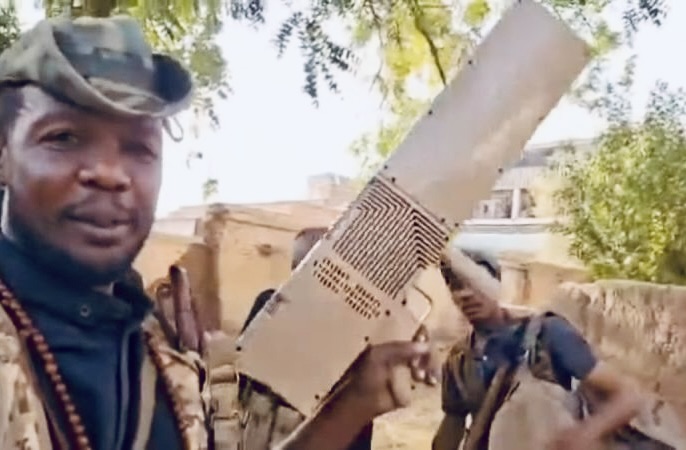
While official documentation remains limited, reliable reports from defence-focused outlets have identified Chinese-made anti-drone jamming systems mounted on RSF vehicles. Satellite and social media imagery verified by experts shows RSF units operating anti-drone jammers and detectors mounted on trucks – systems capable of flooding drone control frequencies up to 2.5 km away. These devices mirror electronic warfare technologies prevalent in Ukraine’s battlefields.
Open-source footage shows RSF commanders claiming kills of advanced Turkish Bayraktar drones – with crash patterns consistent with jamming technology. These claims are backed by observable wreckage imagery from battle zones, which often shows drones burning without evidence of missile or projectile impact, reinforcing the presence of signal interference.
Beyond physical drone mitigation, electronic warfare usage likely contributes to localised communication blackouts in contested zones. Independent network monitoring in hotspot clashes has documented abrupt cellphone network outages and satellite phone disruptions coinciding with intense fighting. The patterns are more consistent with signal jamming than infrastructure damage alone.
The global war template localized in Sudan
Sudan’s swift incorporation of drones and electronic warfare systems into daily combat highlights the global interconnectedness of contemporary warfare. The Russia–Ukraine war did not merely expose tactical innovations; it accelerated their global distribution. While in some cases direct sales of Ukrainian weapons to Sudan’s warring parties have reportedly taken place, other times they were developed from copying designs. Conflict footage from Ukraine was analysed, catalogued, and disseminated across military forums, defence think tanks, and open intelligence communities—essentially functioning as a de facto tactical manual for modern combat.
Component markets have made parts widely accessible. Civilian-sold motors, cameras, and flight controllers now form the core of weaponised drones in Sudan. Dual-use electronics comparisons enable fighters with limited resources to build and modify systems once confined to state military arsenals. Meanwhile, EW components that disrupt communications or GPS also circulate internationally as commercial security tools, easily repurposed for battlefield usage.
The result is a technologically advanced battlefield in Sudan, where actors frequently lack traditional airpower. As one analysis notes, both sides have increasingly secured “advanced technology to achieve breakthroughs across the country,” amplifying the lethality of engagements and the toll on civilians.
This technological saturation has direct humanitarian impacts. Médecins Sans Frontières (MSF) teams recently treated nearly 170 people injured by drone strikes across Sudan in a two-week period, highlighting how civilian areas, schools, markets, and healthcare facilities are caught in aerial exchanges.
The infusion of EW amplifies this danger. Communication disruptions not only hinder civilian coordination and emergency response but also complicate humanitarian access and aid delivery in contested zones.
Sudan’s conflict therefore illustrates a stark truth about modern war: technological innovations do not remain localised. Once proven in one theatre, they quickly diffuse to others—often with devastating effect. Sudan’s skies, saturated with drones, and its airwaves, filled with jamming interference, reflect a new age of warfare imported from distant battlefields but fought over Sudan’s cities, roads, and civilians