

Remembering El Fasher and those still detained
28 April 2026
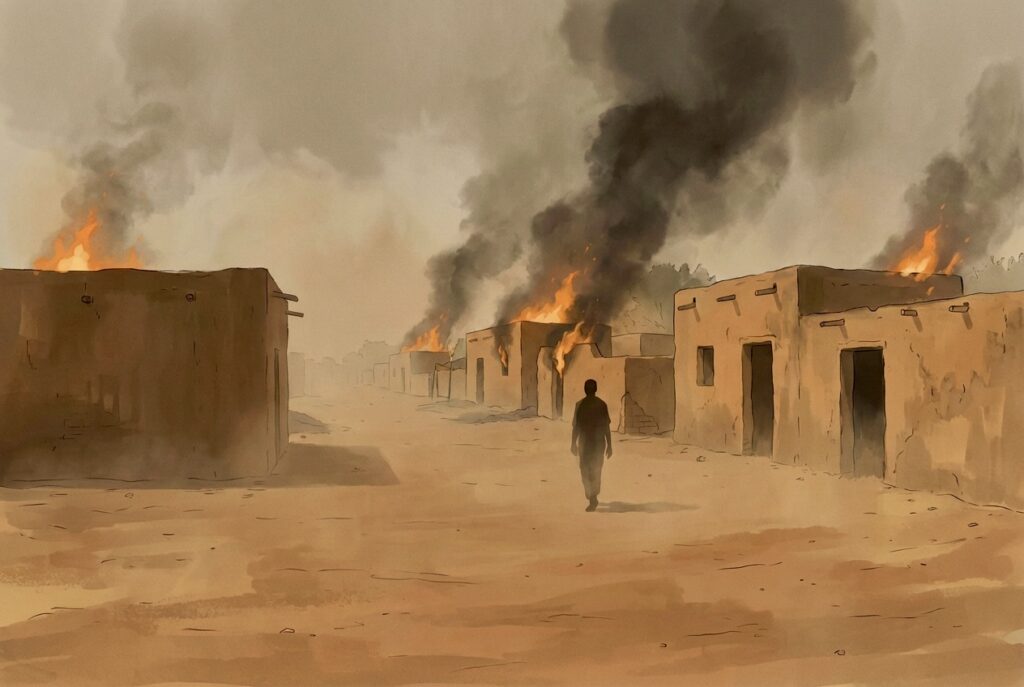
It has been six months since the Rapid Support Forces (RSF) seized El Fasher, the capital of North Darfur State, in a bloody raid that the UN Independent International Fact-Finding Mission characterised as having “the hallmark of genocide”. While the violent six-day raid last October is over, many people have remained detained or, worse, have gone missing ever since.
Halima Ismail* survived the war in El Fasher, but she lost three of her brothers when the RSF stormed the city. They were most likely captured, according to information she received. Since then, this woman and her family have been living in agony, amid frequent human rights reports about the RSF arresting thousands of civilians under harsh conditions in the region.
“The Rapid Support Forces did not stop at killing and displacement but also arrested thousands of citizens and demanded ransom from their families, which doubled the suffering,” Halima told Ayin.
Halima found no tangible trace of her three brothers throughout this period. Nevertheless, she continues to receive calls from RSF militants demanding that she pay sums of money if she wants her brothers to return. However, as a displaced person without funds to cover a daily meal, she remains without means to help her siblings.
“The hardest thing we face is the constant psychological blackmail. Some of my brothers were killed during the attack, and the rest of them are detained. We cannot reach them or know where they are.”
Her pain and sorrow intensify with each call from the militants. “There are no guarantees. Many families have transferred money in exchange for the return of their detained and kidnapped sons, but it was all a scam, and they never came back. That’s the most painful aspect of this whole situation,” she told Ayin. “People are forced to cut back on their daily bread and borrow money to pay the ransom, only to find that both the kidnappers and the detainees have disappeared.”
 Detained in El Fasher
On February 9, the Popular Resistance in North Darfur, a pro-army group, stated that the RSF were holding 9,000 citizens in Shala prison near El Fasher and that 300 of them had died due to medical neglect. Similar reports indicate that the RSF has designated sites in South and Central Darfur as detention centres for citizens arrested in Darfur and Kordofan, where they are held under harsh conditions. To date, the RSF has not commented on these reports.
In addition to Shala Prison in El Fasher, the name of Taqris Prison in Nyala, South Darfur State, has emerged as one of the centres designated by the RSF for detained civilians. Detainees are transferred to it from El Fasher and other areas in the region.
 Detained in Nyala
According to Darfur-based journalist Issa Dafallah, many El Fasher detainees are being held in Kabo or Daqris prisons in Nyala, South Darfur State. After the outbreak of war, Dafallah says, this prison became a detention centre for those brought from Kordofan, Khartoum, and El Fasher.
“There are reports of harsh interrogations and financial bargaining [for their release],” says Dafallah. “The danger lies in the lack of separation between civilians and the military; the Rapid Support Forces treat everyone as military personnel or potential enemies, thus depriving civilians of any protection guaranteed by international laws.”
Amid scarce information and the very real health risks linked to the RSF detention centres, many families fear the worst for their missing relatives. “My brother has been detained for two months by the Rapid Support Forces in the Darfur region,” Ali Osman, a former El Fasher resident, told Ayin. “We do not know his exact place of detention or his health condition. He has young children who constantly ask about him, and they have no one to support them in these harsh conditions.”
Mohamed Idris* still has no idea where his brothers are being held in Nyala. “I have two brothers who are detained, Ahmed and Al-Mughith, and we have had no news of them for months. Unconfirmed reports indicate that they were transferred to Daqris prison in Nyala. “Living with the loss of two brothers who represent the main pillar of the house is extremely cruel.”
Idris is appealing to human rights organisations and international bodies, including the Red Cross, to pressure the Rapid Support Forces. “I contacted the Red Cross, and they said they are looking into the matter, but we haven’t received any reassurance yet. The psychological suffering our family is enduring every moment is indescribable.”
 Return to El Fasher
For her part, Alawiya*, a woman from North Darfur, never lost hope of finding her husband and brother, which prompted her to risk returning to El Fasher to search for them. “My husband was arrested by the Rapid Support Forces on the day the city fell, and since then we haven’t found any trace of him. They haven’t demanded a ransom, which makes his fate completely unknown.”
As for her brother, she found him detained within Saudi Hospital in El Fasher. “My brother was taken with about 6,000 people from the Qarni area to the land port in El Fasher. There, they were accused of being affiliated with the army, even though they were unarmed civilians,” she said. Alawiya’s brother was forced to bury those who were killed by the RSF in El Fasher. “They were also used as forced labourers in the Saudi hospital to serve the wounded from the Rapid Support Forces,” Alawiya adds. Later they were taken out to pillage the houses of wealthier citizens and burn their properties to conceal the looting.
 Legal accountability
Legal expert Iqbal Ahmed says the war in Sudan resembles a guerrilla war, where the rules of international humanitarian law requiring the protection of civilians and civilian objects are not respected. Civilians have become the primary target, with complete impunity.
“What is happening in El Fasher is a combination of arbitrary detention and enforced disappearance,” Iqbal told Ayin. “Arbitrary detention means arresting a person without following legal procedures, while enforced disappearance means not acknowledging the arrest or the place of detention. Those detained today are completely outside the protection of the law.”
Iqbal points out that the provisions of international law regarding detention centres (healthcare, food, judicial guarantees, and family visits) amount to a “big zero” in the prisons of war profiteers. “Arrests are carried out in conditions that lead to death by starvation, and torture has become a systematic process of physical elimination as a form of revenge.”
Iqbal Ahmed asserts that criminal responsibility extends beyond the direct perpetrators to the military hierarchy. “The primary person directly responsible is Hemedti and the lower-ranking military officers [in the RSF]. Everyone involved in any step, even a guard at the detention facility, bears some responsibility for the enforced disappearances and torture.”
Iqbal criticises the lack of accurate statistics, which is due to the fragmented documentation efforts. “The human rights community is disorganised – we need to form unified networks that function as statistics and documentation teams because we are dealing with lives, not just numbers,” she said. According to Iqbal, there are thousands of women and children missing and detained from El Fasher. “We must raise our voices loudly, because every passing day is an agonising ordeal for a family whose hearts are fixed on knocking on doors and whose eyes are fixed on a path that leads nowhere.”
* The names is changed to protect the source’s identity