


Satellite imagery reveals the splintering and burning of Kauda
8 June 2026
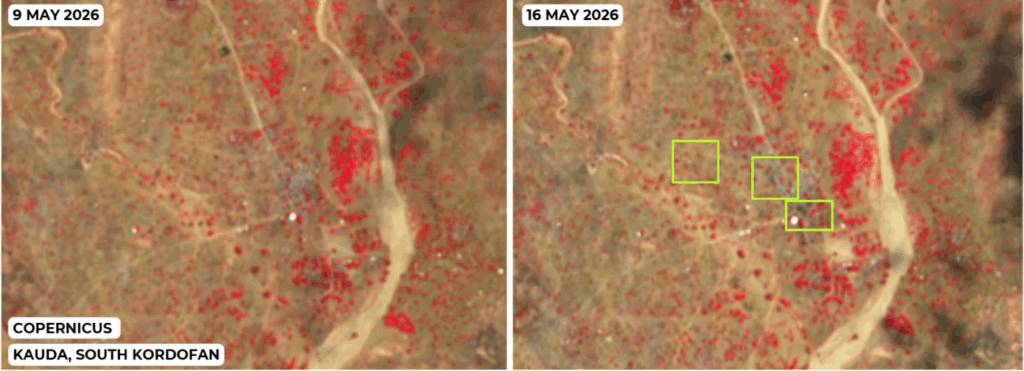
A recent investigation by the Centre for Information Resilience (CIR) and Sudan Witness exposes a devastating arson campaign taking place last month in the Nuba Mountains, South Kordofan State. For decades, the town of Kauda has stood as the defiant, symbolic heartland of the Nuba people and their resistance movement, the Sudan People’s Liberation Movement-North (SPLM-N). But over two harrowing weeks from 2 to 16 May, a joint investigation reveals an arson campaign that burnt Kauda’s central market and five surrounding rural settlements. The internal conflict within the Nuba community continues to this day, according to local sources.
Deadly fires
According to the Sudan Doctors Network, violence last month killed at least 61 civilians, including women and children, who were targeted during clashes between the SPLM-N, led by Abdel Aziz al-Hilu and the Ottoro tribe in Kauda. “Residents were entirely cut off from food and water,” one displaced resident stated on social media. “People with disabilities and the sick were left behind in their houses… some burnt inside.” On 8 May, the SPLM-N acknowledged in a statement that it had launched attacks in the Ottoro area to quell a localised mutiny linked to longstanding land disputes and border demarcation issues. Part of these disputes concerned the Ottoro’s refusal to allow the SPLM-N-allied Rapid Support Forces (RSF) to mine in their area, local and international reports said.
According to CIR’s satellite data, the geographical spread and temporal progression of the fires prove that the incident was no localised accident but rather a sustained two-week campaign, CIR’s satellite data. Open-source investigators mapped the destruction using a combination of NASA heat data, social media footage, and satellite imagery from Planet and Copernicus.
Between 2 and 10 May, satellite imagery revealed a growing cluster of burn scars on sparsely populated farmland, roughly 1.5 kilometres west of Kauda airport. The fires rapidly spread eastward; between 9 May and 11 May, additional burn scars appeared at a rural settlement 4.5 kilometres east of Kauda.
By 13 May, filmed footage shows buildings in Kauda’s central market in flames. The destruction rippled out to the periphery on 16 May, with imagery capturing advanced burn scars engulfing two final settlements in rural Kauda, situated roughly 3 kilometres west of the village centre and 1.5 kilometres east of the town of Lwere.
The widespread destruction of agricultural land severely jeopardises long-term food security and means that, even if the internal mutiny is suppressed, the displaced civilian population faces an incredibly bleak prospect of return.
Alliances in dispute
The violence originally flared from an escalation of intercommunal tensions between the local Ottoro and Shwaya Nuba subgroups in March, according to a 2 June statement by SPLM-N Secretary-General Ammar Amoun Daldoum. The SPLM-N said they have launched an investigation into the clashes in the Bayami Dabi and Kauda areas of Heiban County in an attempt to quell the violence.
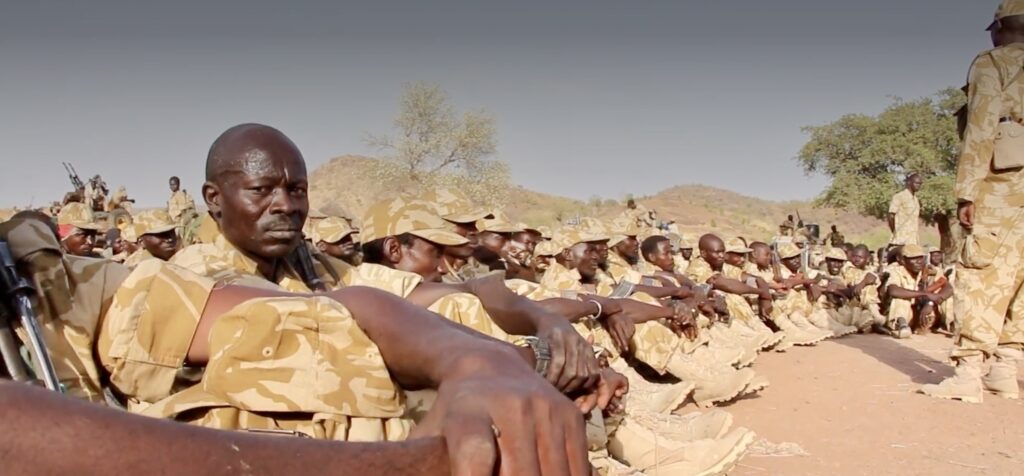
According to data from the Armed Conflict Location & Event Data Project (ACLED), the alliance between the SPLM-N and RSF is the primary driver of the current fracturing in Kauda. The Nuba people carry deep historical trauma from the 2000s and 2010s, when Janjaweed militias (now termed the RSF) and government forces subjected Nuba communities to relentless aerial bombardments and scorched-earth campaigns. ACLED notes that the SPLM-N central leadership’s perceived tolerance of RSF operations has caused some internal tensions, which are made worse by grievances over alleged RSF mining activities and aggressive recruitment drives on ancestral Ottoro land.
Local sources told Ayin that the internecine conflict in Kauda and surrounding areas of Heiban County is ongoing.