

5 May 2026
To keep our readers informed of the multitude of events taking place in Sudan amidst the ongoing, devastating war, we have developed a series of weekly news briefs covering major topics of the week.
In this week’s edition:
- The army: UAE drones launched from Ethiopia to attack Sudan
- Sudan forms joint security force to curb gold smuggling
- Sudanese cabinet dismisses social security investment fund official
- Controversy surrounds statements regarding doctors cooperating with the army
- Lake Nubia closed for investigation into toxic algae and water pollution
- Ground battles in Kordofan slow as airstrikes on El Obeid intensify
 1) The army: UAE drones launched from Ethiopia to attack Sudan
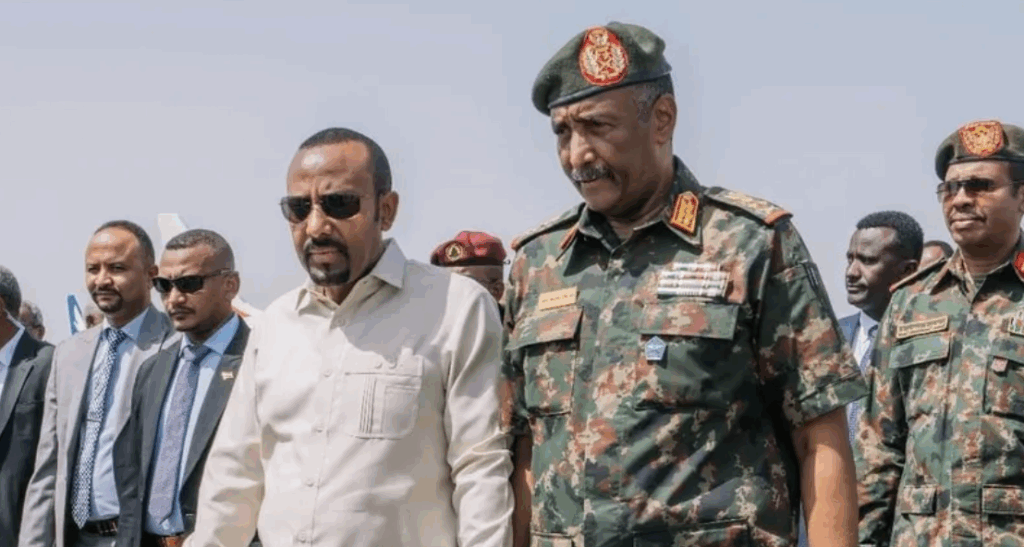
Sudanese army officials have accused Ethiopia and the United Arab Emirates of launching coordinated drone attacks on multiple Sudanese cities, resulting in widespread civilian and military casualties. Over the past two days, the strikes have targeted the states of Khartoum, White Nile, Gedaref, Al-Jazeera, and the city El-Obeid in North Kordofan State.
During a press conference in Khartoum, Sudanese army spokesman Brigadier General Asim Awad Abdel Wahab announced that the government possesses documented evidence of this sovereignty violation. “According to data collected by official authorities, on March 1st, three drones took off from Bahir Dar Airport inside Ethiopian territory and carried out sorties targeting the states of White Nile, Blue Nile, North and South Kordofan,” he said.
Data recovered from a drone shot down in North Kordofan on March 17 confirmed it was owned by the UAE (bearing serial number S88) and operated from Bahir Dar. According to the army, another drone that recently bombed Khartoum International Airport took off from the same Ethiopian location before being tracked south of Khartoum.
The recent strikes on Khartoum’s newly reopened airport caused significant panic. “The attack on Khartoum airport coincided with the presence of government officials, including Foreign Minister Mohi El-Din Salem, who were waiting to depart for Rwanda,” a source at the airport told Ayin.
The drone campaign has caused extensive damage across the country, striking military zones in Omdurman, civilian homes in Al-Faw, and a sugar factory in White Nile. Additionally, a drone targeted the family home of Sudan Shield Forces commander Abu Aqla Kiekel, killing two of his brothers alongside several women and children, an incident that has drawn widespread public condemnation.
 2) Sudan forms joint security force to curb gold smuggling
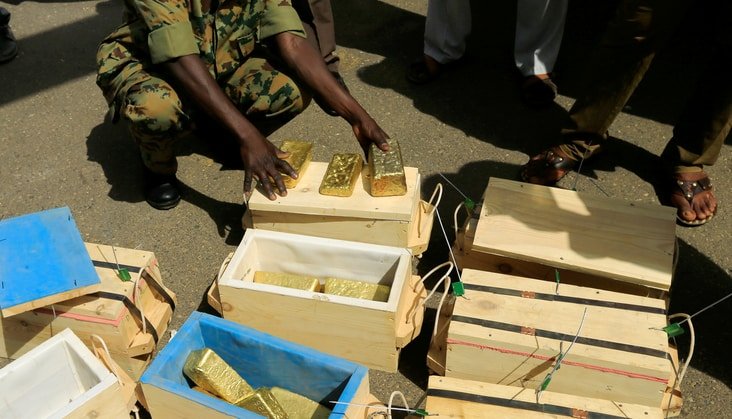
The Sudanese government has established a joint security force comprising military and police units to combat gold smuggling and secure mining markets, mines, borders, and airports. The initiative aims to protect the country’s primary economic resource amid a worsening financial crisis.
Officials in the Transitional Sovereignty Council are pushing to reach $3 billion in gold revenues this year. Sudan’s economy has been heavily battered by an ongoing three-year war, compounded by skyrocketing fuel and consumer goods prices linked to international conflicts and the closure of the Strait of Hormuz.
In early May, Minister of Minerals Nour El-Daim Taha met with security leaders, emphasising that the country’s resources are being targeted. Prime Minister Kamil Idris echoed this urgency, stressing the need to halt gold smuggling to prevent billions in annual losses and address a national trade deficit projected to reach $3.8 billion this year.
However, economic analyst Omar Abshar pointed out the deep-rooted challenges of this initiative. “Combating gold smuggling is also linked to stopping the war, achieving economic and political stability, and restructuring the security and military sector,” he noted, also highlighting the involvement of army-allied armed groups whose official export contributions remain unverified.
Abshar further explained that the gold sector remains a massive funding source for militant groups. He stated that the Rapid Support Forces continue to smuggle gold from western mines through Chad, South Sudan, and Central Africa, securing millions of dollars monthly to fund their operations.
 3) Sudanese cabinet dismisses social security investment fund official
Prime Minister Kamil Idris surprised the government in late April 2026 by dismissing Saif al-Din Koko, the Commissioner of the Social Security Investment Fund. A government source indicated the decision is part of a broader performance review of financial bodies and a government reform plan.
The abrupt dismissal has triggered a political dispute between the Prime Minister and Finance Minister Jibril Ibrahim. The Social Security Investment Fund falls under the Ministry of Social Welfare and Development, a department that has been controlled by a representative of the Justice and Equality Movement since 2021.
Economic analyst Mohamed Ibrahim noted that the dismissed commissioner is currently facing corruption allegations. The massive fund, with assets estimated at $5 billion, holds significant investments across the cement industry, banking, real estate, and private healthcare, including the Social Security Hospital in Merowe.
The fund’s operations have recently drawn intense public scrutiny. Earlier this year, reports emerged that the fund was negotiating with the Ministry of Health to privatise delicate medical operations, raising alarms among health experts about corporate dominance over government hospitals.
Highlighting the political friction behind the scenes, Ibrahim explained, “Finance Minister Jibril Ibrahim wants to keep the Social Security Investment Fund under the management of a representative from the Justice and Equality Movement, while the cabinet wants to appoint a technocrat, ignoring the movement’s demands.”
 4) Controversy surrounds statements regarding doctors cooperating with the army
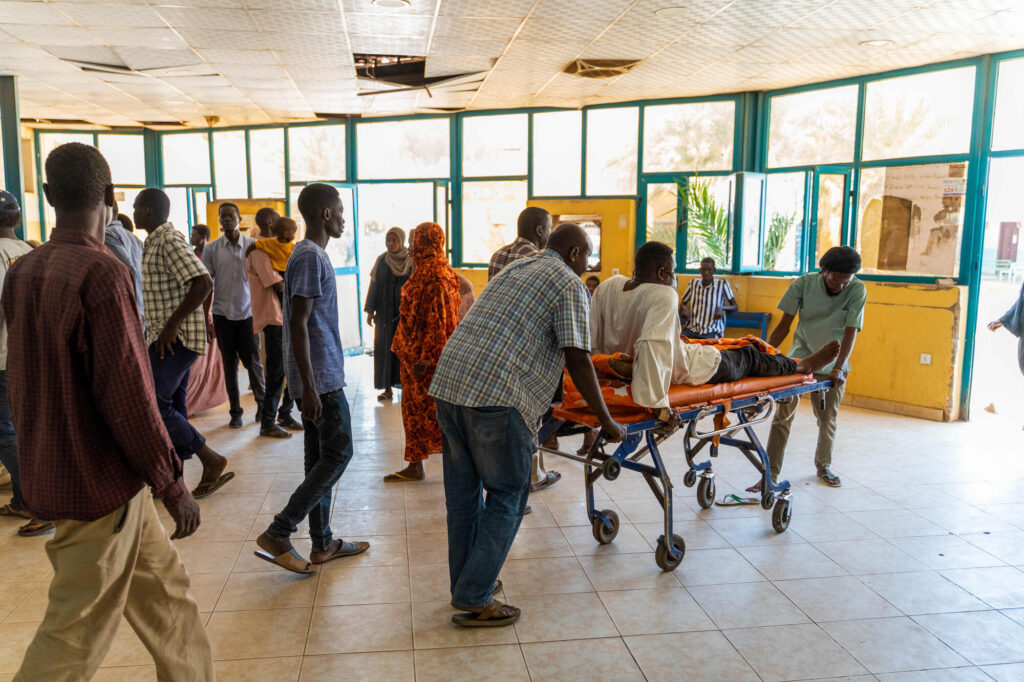
Recent claims by Sudanese Army Commander Lt. Gen. Abdel Fattah al-Burhan that some doctors in Khartoum acted as informants for the military have ignited a fierce backlash. Medical and human rights organisations have strongly condemned the remarks, viewing them as a “direct threat to the safety of medical personnel.”
During a recent meeting of health ministers, Burhan alleged that doctors operating in RSF-controlled areas provided the army with intelligence on troop movements. The preparatory committee of the Sudanese Doctors Syndicate quickly rebuked the claim, warning that it severely compromises medical neutrality.
The Syndicate stated that “any official statement that casts doubt on the professionalism of doctors or puts them at risk represents a direct threat to what remains of the humanitarian space in the country, and may be interpreted as a cover for further violations.”
Conversely, the Ministry of Health defended Burhan, claiming his statements validated prior rumours of unwarranted amputations and contaminated blood injections. Despite this, the Ministry emphasised, “The bright history of doctors and health workers in Sudan, their tireless work, their concern for the interests of Sudanese people, and their high professionalism cannot be obscured by the actions of a small group.”
The human rights group Emergency Lawyers rejected the political weaponisation of healthcare, stating that “medical work, by its very humanitarian nature, cannot in any way be turned into military or intelligence activity, and any attempt in this direction represents a serious deviation from the rules of international protection.” Since the conflict began, over 173 health workers have been killed amid targeted attacks on medical facilities.
 5) Lake Nubia closed for investigation into toxic algae and water pollution
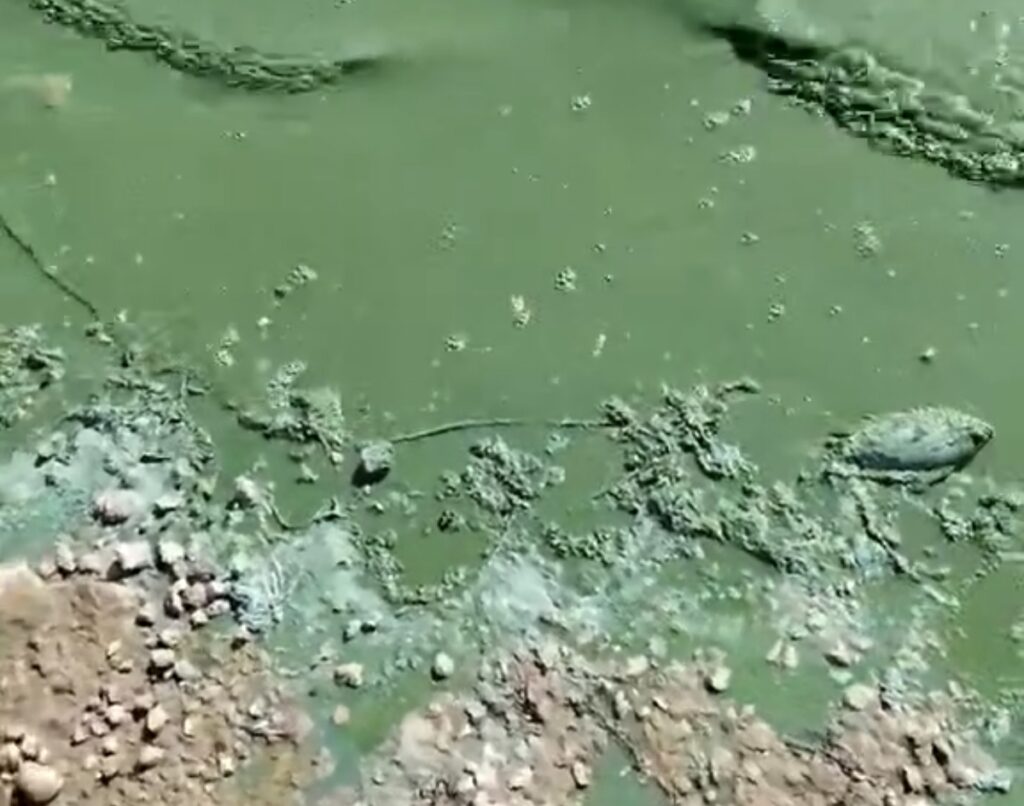
The Northern State government has ordered the immediate closure of Lake Nubia near the Wadi Halfa locality due to severe water pollution. Starting Monday, May 4, fishing and all Nile activities have been strictly prohibited in the “Khor Musa Pasha” area following a two-month surge in toxic algae.
Al-Tayeb Habib Allah, Secretary-General of the Supreme Council for Livestock, Fisheries and Pastures, confirmed the ban will remain active until the technical causes behind the “algal nutrients” are fully identified. Authorities hope the closure will contain the dense algae within the creek and protect the health of the local fish stock.
A specialised technical team is currently conducting a “field investigation” to map and combat the pollutants. An official statement clarified: “The lake will remain closed to the movement of fishermen and all Nile activities until the investigation is completed and the final report is issued by the technical working group of the Fisheries and Fish Research Department and the Unified Health Council of the Northern State.”
The environmental crisis has directly impacted local utilities, forcing the Wadi Halfa water station to suspend its operations late last week due to blocked water sources and high algae density.
Locals report that the lake’s water has turned “dark green” in several areas. The sudden ecological shift has sparked widespread community concern that regional mining activities may be leaking toxic materials directly into the water supply.
 6) Ground battles in Kordofan slow as airstrikes on El Obeid intensify
While ground combat between the Sudanese army and the Rapid Support Forces (RSF) in the Kordofan region has notably decelerated, drone warfare has sharply increased over the army-controlled city of El Obeid.
Recent ground skirmishes have been largely confined to the Alouba area southeast of the city. Previously active fronts in Al-Dubaibat, Al-Hamadi, and Kazqil have fallen quiet, though these areas remain largely abandoned as residents flee to El Obeid, Abu Zabad, and Al-Fula to escape the persistent drone threat.
Over the past 48 hours, El Obeid has endured a consecutive series of aerial attacks launched by drones suspected to belong to the Rapid Support Forces. Residents reported loud explosions near the headquarters of the Sudanese Army’s Sixth Division on Monday.
The escalating airstrikes are heavily impacting civilian infrastructure. On Saturday, drone strikes partially destroyed the North Kordofan TV building in El Obeid, prompting fierce condemnation from the Sudanese Journalists Syndicate against the targeting of media institutions.
The Syndicate rejected the treatment of journalists as legitimate military targets, pointing out the dire conditions for the press. They noted that 34 journalists have been killed in the conflict as a result of “systematic practices,” while widespread looting and destruction have forced the majority of media organizations to cease operations.